

REFORESTATION
Part 1- What, where, how !

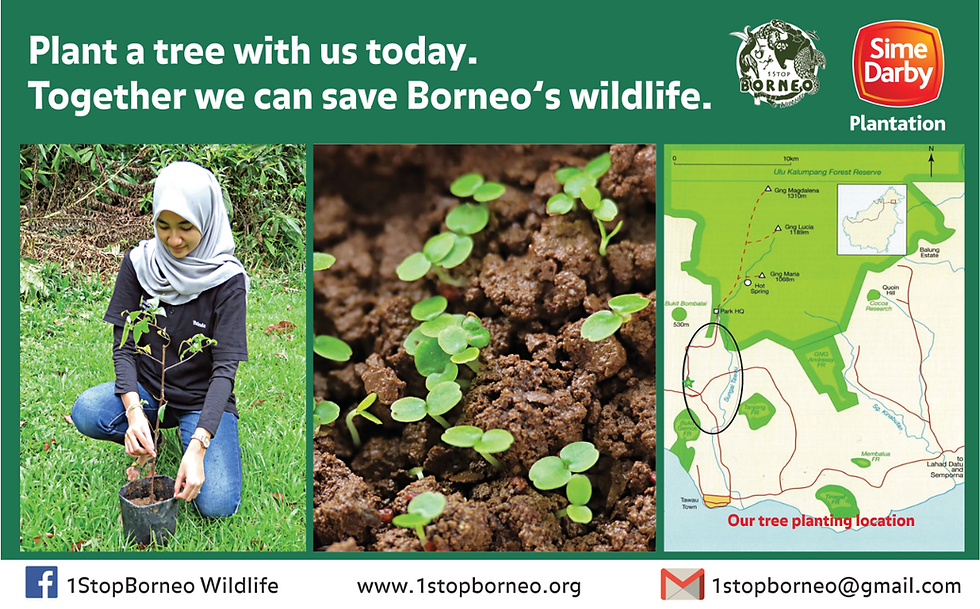
FURTHER OBJECTIVES
To establish any new botanic garden is a long term project which will mostly benefit our children and grandchildren rather than ourselves.
The Plant4Tawau project was established for multiple reasons;
-
To educate visitors on the best practices for restoring damaged forest back to to the original diversity of Borneo’s native forests.
-
To provide wild food for the local wildlife at Tawau Hills especially hornbills, gibbons and langurs allowing visitors to watch these animals at close quarters.
-
To provide a living gene bank of Borneo figs freely available to both Malaysian and overseas researchers into fig ecology, taxonomy and biodiversity.
-
To provide planting material for the much larger adjacent habitat enhancement project described here and other forest restoration projects in Borneo.
-
To carry out field experiments on how best to plant strangling figs on oil palms to enhance the edge of oil palm estates for wildlife habitat throughout Borneo.
-
Our hope is that in 50 years time the Tawau Hills Fig Garden will provide a diverse wildlife rich forest garden which will attract students, researchers and tourists from around the world.
-
Finally we hope that this living example of what is possible will stimulate the creation of hundreds of similar projects throughout Borneo. We can provide free fig seeds and growing advice to anyone interested in similar projects and forest restoration.

Part 2- How do we plant?
a) We grow from the seeds from the fruit
b) Through marcotting process


Part 3-
Species- The following are the species we are growing.
Subcordata,villosa,benjamina,drupacea,microcarpa,cucurbitina,racemosa,callosa,punctata,lepricarpa,nota,rosulata,partietalis,cumingii,caolocarpa,variegata,kerkhovernii,callophylla,septica,franciscia, laran and so on. We plan to plant atleast a minimum of 25 species of ficus and atleats 10 of other fast growing and also hardwood trees.
The following are the species we are growing. More information on them can be obtained at www.borneoficus.info
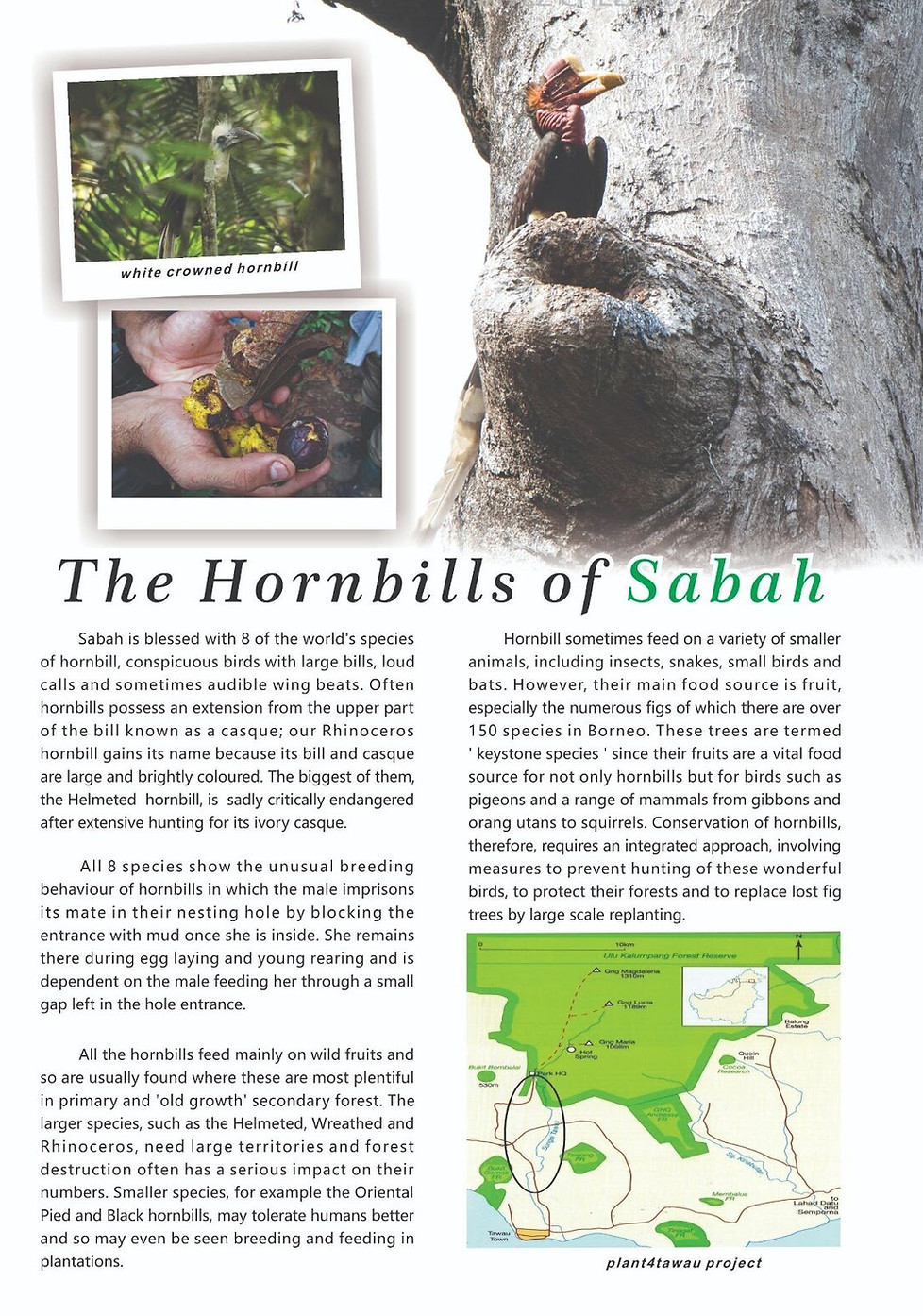
Part 4- Are you a company or a school?


Part 5- Resources


3)Article by Martin

4)Articles by Miyabi and Suzika
-
Influence of gibbon ranging patterns on seed dispersal distance and deposition site in a Bornean forest (Click To Read) by Kim R Mcconkey , David J Chivers (https://www.researchgate.net/publication/236155427_Influence_of_gibbon_ranging_patterns_on_seed_dispersal_distance_and_deposition_site_in_a_Bornean_forest)
-
Fruit selection of a binturong (Arctictis binturong) by focal animal sampling in Sabah, Malaysian Borneo (Click To Read) by Miyabi Nakabayashi, Abdul Hamid Ahmad, Shiro Kohshima (https://www.researchgate.net/publication/290508673_Fruit_selection_of_a_binturong_Arctictis_binturong_by_focal_animal_sampling_in_Sabah_Malaysian_Borneo)
4)Articles by Miyabi and Suzika
-
Influence of gibbon ranging patterns on seed dispersal distance and deposition site in a Bornean forest (Click To Read) by Kim R Mcconkey , David J Chivers (https://www.researchgate.net/publication/236155427_Influence_of_gibbon_ranging_patterns_on_seed_dispersal_distance_and_deposition_site_in_a_Bornean_forest)
-
Fruit selection of a binturong (Arctictis binturong) by focal animal sampling in Sabah, Malaysian Borneo (Click To Read) by Miyabi Nakabayashi, Abdul Hamid Ahmad, Shiro Kohshima (https://www.researchgate.net/publication/290508673_Fruit_selection_of_a_binturong_Arctictis_binturong_by_focal_animal_sampling_in_Sabah_Malaysian_Borneo)
NURSERIES Tawau

Partners


Plant a tree with us!


CURRENT PROJECTS
1. Teck Guan Wildlife Corridor
The Teck Guan Wildlife Corridor in Tawau, Sabah is a restoration area linking oil palm plantation landscapes to the low-altitude forest edge of Quoin Hill. The project responds to habitat fragmentation and degradation by restoring riparian and corridor areas, improving ecological connectivity, and supporting wildlife recovery.
LATEST COMMITMENT A Letter of Confirmation dated 7 August 2026 confirms Teck Guan Group’s support for the FCC project and the project timleine. The landowner commitment also states that no commercial logging, land clearing or agriculture development will be permitted within the demarcated project boundaries during the project lifecycle.

2. Deramakot Reforestation Programme
The Deramakot reforestation programme has expanded from initial restoration work around KM1–Balat and the Mawar Stumping Area to additional sites including the HQ area and Kun-Kun. The programme emphasises Ficus planting because figs are described in the project material as resilient, fast-growing and important food resources for wildlife.
RECENT RESULT The JUly 2026 Kun-Kun monitoring material records a fruiting milestone: some planted figs began fruiting less than a year after planting.


3. Kun-Kun, Tangkulap
KunKun Riverside is located within the Tangkulap Forest Reserve and is described as a recreational area surrounded by forest. The site is already well shaded, but several open areas were identified for additional planting to improve canopy cover, provide more shade and strengthen the site's natural forest character.
LATEST PLANTING 300+ figs were planted on 2-4 May 2026
What is happening now?
-
Recent maintenance records and rapid-growth observations are being used to follow the new planting.
-
Fruiting has already been observed in planted Ficus in less than a year.
-
The July 2026 material records Ficus fistulosa and Ficus annulata among the observed plants.
-
The wider Deramakot programme uses planting, maintenance and monitoring to build wildlife food resources and habitat structure.

4. Plant4Tawau
Plant4Tawau is retained here as an important earlier chapter rather than presented as the current lead project. The current 1StopBorneo reforestation webpage describes Plant4Tawau as an initiative established to demonstrate forest restoration, provide wild food for wildlife at Tawau Hills, build a living gene bank of Borneo figs, supply planting material for larger habitat-enhancement work, and test ways of using figs to improve wildlife habitat around oil-palm areas.
WHY IT MATTERS The Plant4Tawau story helps explain the progression from an ealier Tawau-focused fig and habitat reforestation initiative toward the organisation’s newer corridor-scale and multi-site restoration programmes.

WHAT WE PLANT
Ficus
The Deramakot material reports more than 5,000 figs and flowers planted and highlights Ficus as a strategic group because figs can fruit reliably, provide food for many animals, and support shelter and shade.
Dipterocarps & other native trees
The Teck Guan proposal includes native Dipterocarps and wildlife-friendly Ficus among its planting focus, alongside Laran and other native trees.
Flowering plants
Flowering plants are used to enhance scenery and landscape attraction and to attract pollinating insects and birds.

WILDLIFE BENEFITS
-
Figs are presented as year-round or reliable food resources for diverse wildlife, especially frugivorous birds and primates.
-
The Teck Guan Wildlife Corridor is designed to reconnect fragmented forest pockets and strengthen ecological connectivity.
-
Camera traps are part of the Teck Guan monitoring system, helping document wildlife use of the restored landscape.
-
The Teck Guan biodiversity baseline lists 107 mammal species, 338 bird species, 87 amphibian species and 61 snake species associated with the wider Tawau Hills / corridor landscape.
-
At Kun-Kun, the project team has also recorded a wildlife milestone involving flying frogs at the pond, while the planting work focuses on improving habitat structure and canopy cover.
CORE IDEA Reforestation is not presented simply as planting trees. The programmes combine habitat restoration, wildlife food resources,ecological connectivity and monitoring.
COMMUNITY
The reforestation programmes include people as part of implementation rather than treating restoration as a planting-only activity.
-
Teck Guan includes community engagement, capacity building, outreach, training and knowledge sharing with local communities and Indigenous Peoples.
-
Local execution teams are planned for field labour, patrols and nursery work.
-
The Teck Guan project records tree-planting participation from schools and colleges in Tawau.
-
Deramakot planting activities have involved hired local workers and Sabah Forestry Department staff.
-
The wider objectives include diversified employment opportunities, conservation tourism and increased local conservation capacity.


